
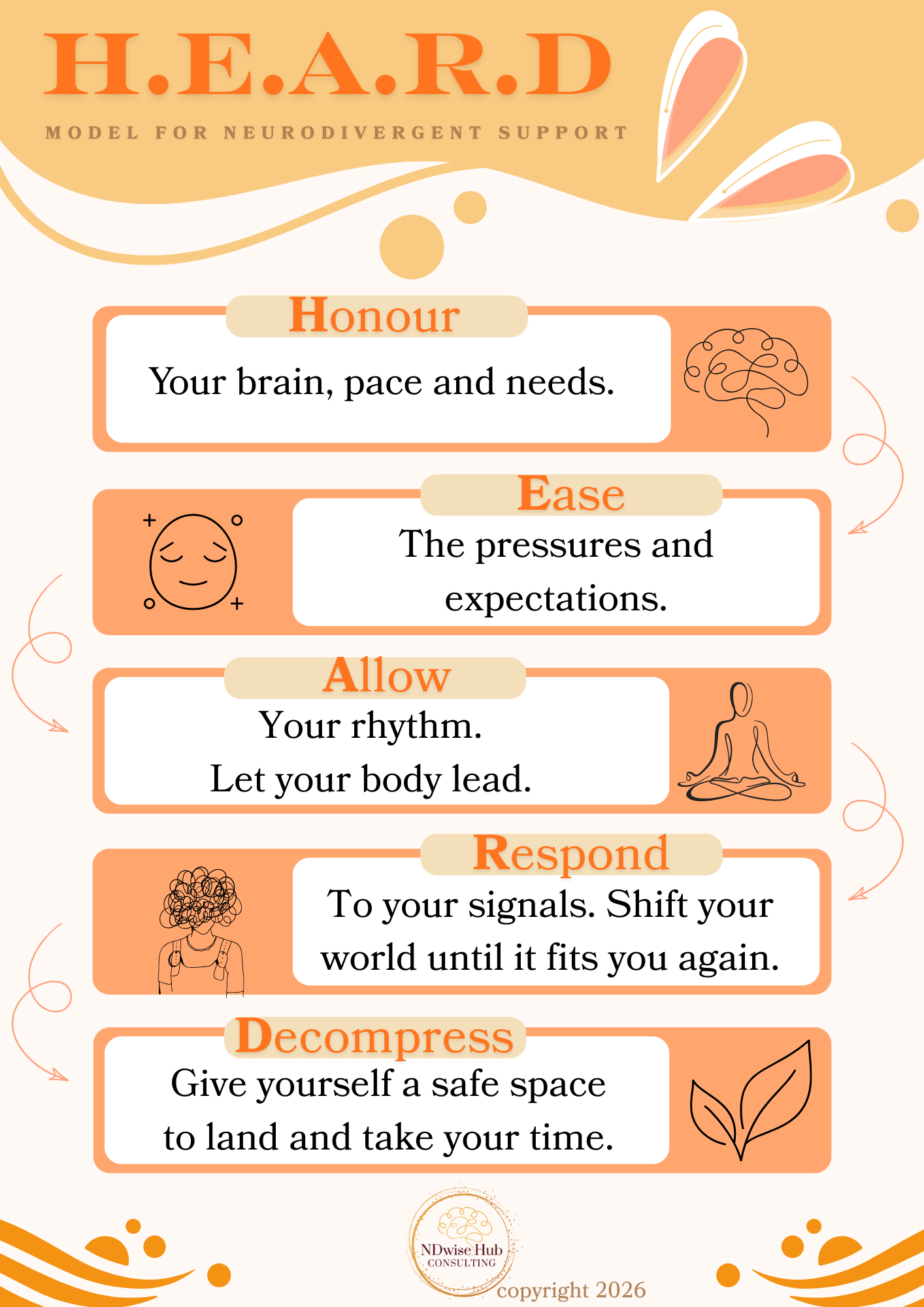
H.E.A.R.D
model for neurodivergent support

This year’s Mental Health Awareness Week theme is action, be it for yourself, others or all.
In light of this and my upcoming session where I aim to reframe dysregulation as misalignment, I’ve created the H.E.A.R.D model for neurodivergent support. I think it fits the theme well, because it changes the focus from passive feeling to active advocacy. H.E.A.R.D is a different kind of action because its purpose is to reduce threat, decrease pressure and prioritise safety. Let me introduce you to it...
The medical model has spent decades attempting to pathologise the neurodivergent experience, treating difference as deficit and interpreting distress as dysfunction. Our internal ecosystem became a collection of symptoms to suppress, behaviours to manage, and deficits to remediate.
In this context, dysregulation is rarely understood as valuable information but as a lack of resilience (urgh!) and flexibility and a refusal to comply with a world built on neuronormative standards.
To move from survival to sustainability, we need something more meaningful than coping strategies. We need a new literacy of the self. And no, I am not talking about self-care in its aestheticised, consumerist form or optimisation disguised as well-being or even a framework teaching us how to tolerate unsustainable conditions better...
What we need is a model that prioritises alignment which is one of the reasons why I created the H.E.A.R.D model for neurodivergent support. Hopefully it gives us the ability to understand our own nervous system clearly enough to stop abandoning ourselves in order to remain legible to everyone else.
Book your space here for May’s webinar - Dysregulation reframed as misaligment
H — HONOUR
We begin with the most disruptive act we can perform: the act of honouring. Many of us were taught very early to distrust ourselves, to override hunger, ignore sensory pain, force eye contact, suppress movement, endure overwhelm and perform normatively at the expense of safety. Eventually, many become so fluent in self-censorship that they lose access to their own signals entirely.
To honour yourself is to interrupt that conditioning since you cannot build a sustainable life while remaining in conflict with the system responsible for carrying you through it.
Honouring means recognising that your sensory profile, processing style, communication needs, and rhythms are information. And information becomes powerful the moment it is no longer filtered through shame.
E — EASE
In performance-driven cultures, ease becomes the equivalent of laziness. How many of us are permanently operating beyond our energetic limits, red-lining our nervous systems to maintain the appearance of coping? The cost of appearing functional remains invisible until collapse inevitably rears its ugly head.
Ease is the refusal to measure your worth by how much discomfort you can endure. It is the decision to reduce unnecessary friction instead of romanticising exhaustion and the permission to lower the external demand until it fits your capacity. The choice to choose the shorter route, the quieter environment, the modified schedule, the alternative form of communication or the system that actually works for your brain rather than the one that looks most acceptable from the outside.
Ease is sustainability, because a nervous system consumed entirely by survival has very little left for curiosity, connection, creativity, or joy.
A — ALLOW
If honouring is recognition, allowing is embodiment. This is the point where self-understanding becomes visible.
To allow is to stop rehearsing your own existence. It is the understanding that your rhythms are not inherently wrong simply because they differ from neuronormative expectations. Your need for movement, silence, repetition, deep focus, predictability, recovery, or sensory regulation should never require moral justification.
We know that the body communicates truth long before the mind has language for it, so allowing is what happens when we finally start listening.
R — RESPOND
Most traditional regulation frameworks focus on increasing tolerance. The misguided sense of purpose behind these approaches rests on the belief that the brain is plastic enough that, if someone toughs it out for long enough, the pain will eventually disappear. Spoiler alert : it doesn’t.
The result is rarely random, but rather the accumulated consequence of sensory overload, cognitive saturation, social translation fatigue, interoceptive confusion, unpredictability, masking, or environments that continuously demand adaptation without reciprocity.
Responding means treating those signals as meaningful.
The goal here is not perfect regulation, because that’s unattainable at the best of times. The goal is reducing unnecessary friction between the nervous system and the world it is attempting to inhabit.
D — DECOMPRESS
Neurodivergent nervous systems need longer, deeper recovery cycles than neuronormative culture allows, yet rest is still treated as something that must be earned through productivity.
Decompression rejects that premise entirely and it recognises recovery as non-negotiable maintenance.
The dark room, the weighted blanket, the same song on repeat, the special interest deep dive, the silence after social demand, the hours needed for the nervous system to unclench itself from the day… we are not avoiding life but rather returning to it in a way.
Without intentional decompression, we may remain suspended in low-level survival states for so long that dysregulation begins to feel indistinguishable from our identity, so decompression creates the conditions for return to embodiment.
The aim of H.E.A.R.D is to move us away from the exhausting pursuit of becoming more manageable, more productive, more palatable, and more compliant. Can you finally allow yourself to be H.E.A.R.D?
On the 20th of May, I am aiming to reframe dysregulation as misalignment.
If this interests you, please book your space here. A recording will be provided to all ticket holders.
Upcoming events:
On the 19th of June you can find me in London, speaking at the Autism & ADHD Show.
In August I am taking part in the Autistic Mental Health Conference.
⭐ If you’re on any social media, come join me on Facebook, Instagram or LinkedIn.
⭐ Come and have a look at my website, to find out what I do, who I am and browse a catalogue of resources.

I love this and all you write, and share it with others whenever I can. Your understanding and values and compassion and how you are able to articulate all this is powerful and needs to be heard. So glad to get your newsletters and writing.
I love this so much, especially the 'ease' and what you wrote here "refusal to measure your worth by how much discomfort you can endure".